![feature[23] white and gold logo](https://www.feature23.com/hubfs/f23-logo-white-with-gold.svg "feature[23] white and gold logo")
Build vs Buy Software: A Practical Decision Framework (2026)
You don't need a 50-slide deck to make this call. You need to be honest about three things: what the software has to do, what it's worth to your business if it works, and whether your team can actually run it once it exists.
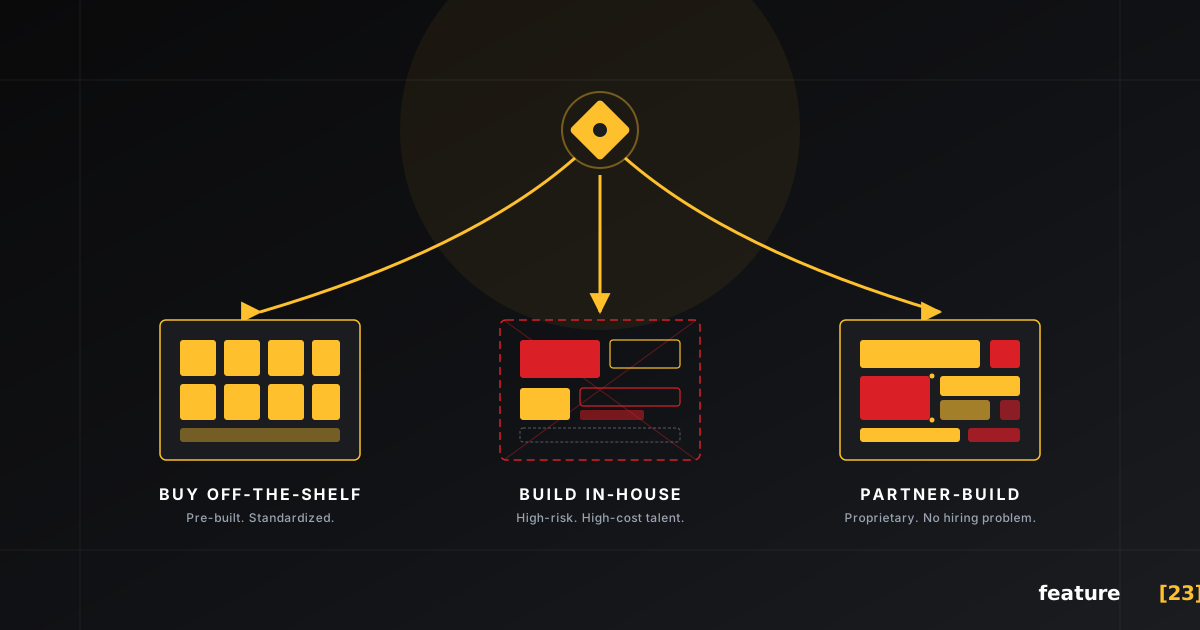
Most build vs buy software debates get stuck because they treat the decision like a binary. It isn't. There are three real options: buy off-the-shelf, build in-house, or partner with an engineering firm to build something proprietary. Each is the right answer in different situations, and choosing the wrong one is expensive in different ways.
Three Options, Not Two
The classic framing leaves out the option most mid-market companies actually need. That omission is expensive: Gartner Digital Markets found 68% of fast-growing businesses regret a software purchase, and 31% have already replaced software because it cost too much (Gartner, 2024). A lot of that regret traces back to a choice made between only two doors.
Here are the three:
- Buy off-the-shelf. A SaaS product or commercial system that fits your process well enough.
- Build in-house. Hire and run an engineering team that owns the software start to finish.
- Partner-build. Work with an outside engineering firm to design and build proprietary software you own, with a smaller internal team or none at all.
Comparing option one against option two while forgetting option three exists is where this usually goes wrong. For most operators in the $50M to $500M range, partner-build is the realistic middle path between buying something that doesn't quite fit and committing to a long-term hiring problem.
| Buy off-the-shelf | Build in-house | Partner-build | |
|---|---|---|---|
| Time to first value | Weeks to 3 months | 9 to 18 months | 4 to 12 months |
| Who owns the code | Vendor | You | You |
| Ongoing cost shape | Recurring per-seat, rises with headcount | Fixed payroll, rises with salaries | Project spend, then a support retainer |
| Fit to your process | Whatever the vendor built | Exact | Exact |
| Talent risk | None | High. You own hiring and retention | Carried by the partner |
| Biggest failure mode | Paying custom money for software you don't own | Team you can't keep staffed | Briefing a partner with the wrong spec |
| Best when | The process is standard | Software is your advantage and you can staff it | Software is your advantage and you can't staff it |
When Should You Buy Off-the-Shelf?
Buy when your problem looks like a thousand other companies' problems. The economics are decisive: organizations leave an average of 36% of their SaaS licenses unused, and business units now control 81% of SaaS spend while IT directly manages just 15% (Zylo, 2026). That waste is a buying-discipline problem, not an argument against buying.
Payroll. Email. Standard accounting. Core CRM. The vendors in these categories have spent more than you ever will. You won't out-build them, and you shouldn't try.
Trouble starts when off-the-shelf gets sold as a fit for a process that isn't actually standard. Most purchase regret isn't about the sticker price. It's about the customization work, the integrations, the workarounds, and the team time spent forcing a platform to behave like your business.
A threshold worth writing down: if the customization plan around a SaaS product is heading toward six figures, stop. You're about to pay custom-software money for software you don't own, and you'll pay it again at every renewal and every upgrade.
When Does Building In-House Actually Make Sense?
Build in-house when the software is part of how you compete and you can genuinely sustain an engineering organization. The US median wage for software developers is $133,080 (BLS, May 2024), which lands near $200K fully loaded once you add benefits, equipment, and overhead. That number sets the floor for everything that follows.
If the way you route service calls, underwrite policies, manage inventory, or coordinate field crews is how you win, a generic product flattens you into the same shape as your competitors. That's a real strategic cost, and it justifies real spending.
Now the honest math. A serious build needs three or four senior engineers, plus a technical lead, plus someone who can actually run the team. Call it $1.1M to $1.5M in annual run-rate before a single feature ships. And that run-rate doesn't pause when the first version is done, because software you own is software you maintain.
Most regional and multi-regional operators genuinely can't sustain that, and the reason usually isn't budget. It's geography and local talent market. A building-products company headquartered ninety minutes from a major metro will lose senior engineering candidates to remote-first employers paying coastal rates, over and over. We've watched capable companies try this twice before concluding the third option was always the right one.
Partner-Build: The Option Most Frameworks Skip
Partner-build fits when the software must be proprietary but a permanent in-house team isn't realistic. US onshore engineering firms typically charge $100 to $300 per hour (Clutch, 2026), and a meaningful custom build runs six to seven figures. The partner absorbs the talent problem, the methodology, and the senior bench. You keep the asset.
That sounds expensive until you compare it against the alternatives honestly. Against an in-house team, you're trading a permanent $1.2M payroll commitment for scoped project spend. Against a bad off-the-shelf purchase, you're trading a known cost for the cost of replacing a platform eighteen months in, after your team has already built two years of workarounds on top of it.
What partner-build buys that neither other option does: continuity without the hiring problem. The team that scopes the work also builds it, and is still there when you need version two.
The tradeoff is real, so name it. You're paying for senior engineering, not commodity hours. And you're taking on a dependency, which means the quality of the relationship matters as much as the quality of the code.
Where Does Outsourcing Fit?
Outsourcing is a staffing model, not a fourth strategic option, and conflating the two causes most of the disappointment. With only 31% of IT projects fully succeeding and root causes now traced to strategic alignment rather than process execution (Arcidiacono, PM World Journal, 2026), cheaper hours don't fix the thing that's actually broken. They scale it.
Two models get conflated here, and the difference matters:
- Staff augmentation and offshore development give you hours against a spec you wrote. Rates are lower. The thinking stays your job.
- Partner-build gives you a team that helps decide what to build, then builds it. Rates are higher. The thinking is included.
Offshore works well when the spec is genuinely settled and the work is well-understood. It works badly when the requirements are still forming, which is the situation most mid-market operators are actually in when they start asking build vs buy questions.
If you can't yet answer "what does this software need to do, and how will we know it worked," lower hourly rates will not save the project. They'll just let you spend the budget faster.
What Does Each Option Cost Over Three Years?
Three-year total cost of ownership is where build vs buy decisions usually invert. At a median SaaS spend of $9,455 per employee per year (Zylo, 2026), buying looks cheapest in year one and often isn't by year three, because per-seat licensing scales with headcount while a build is a largely fixed asset. Every assumption in the model below is stated so you can substitute your own.
Scenario: a 400-employee operator replacing one core operational system. 150 users. Illustrative only. Your numbers will differ.
| Buy (SaaS) | Build in-house | Partner-build | |
|---|---|---|---|
| Year 1 | $150K implementation + $270K license | $1.2M team run-rate | $75K discovery + $700K build |
| Year 2 | $270K license + $200K customization | $1.2M team run-rate | $250K build completion + support |
| Year 3 | $290K license (seat growth) | $1.25M team run-rate | $250K support and enhancement |
| 3-year total | ~$1.18M | ~$3.65M | ~$1.28M |
| You own at the end | Nothing | The software and the team | The software |
Assumptions: SaaS at $150 per seat per month with 7% annual seat growth; in-house at four engineers plus a lead and a manager at $200K fully loaded (BLS, May 2024); partner-build at blended $175 per hour (Clutch, 2026).
Two things fall out of this that surprise people. First, buy and partner-build land close over three years, and partner-build leaves you owning an asset. Second, in-house isn't expensive because engineers are expensive. It's expensive because you're buying permanent capacity to solve a finite problem.
How the Decision Changes by Software Category
The right answer shifts by category, and treating "software" as one decision is why portfolios drift. Large enterprises now add an average of 21 applications per month, with business units controlling 81% of the spend (Zylo, 2026). Without a per-category rule, every team makes this call independently and nobody makes it well.
Internal business and operations software
Usually the strongest case for building. Operational workflow is where mid-market companies actually differ from each other, and it's the category where off-the-shelf fit degrades fastest as you add locations, service lines, or acquisitions. If your operations team maintains a spreadsheet that reconciles two systems the vendor said would integrate, you already have your answer.
Analytics, BI, and reporting
Buy the platform, build the model. Visualization is a solved commodity and the vendors are very good at it. What isn't commoditized is the data model underneath: how you define a job, a margin, a completed install. That definition is yours and no vendor can supply it.
CRM and sales tooling
Almost always buy. Pipeline management is genuinely standard, ecosystems are deep, and the integration surface is well-trodden. One exception: when your sales motion is unusual enough that you're configuring around the tool rather than with it. That happens more in multi-step B2B and dealer or distributor models than most teams expect.
Manufacturing, field service, and logistics
This is the most mixed category, and the one where partner-build earns its keep. Core ERP is a buy. Scheduling, dispatch, quoting, and yard or route logic are frequently where the operating advantage lives, and they're frequently what the ERP handles worst. Building a focused layer on top of a purchased core is often the right shape, which is roughly what we built for a multi-state fence and rail operator.
Authentication, payments, and compliance infrastructure
Buy, nearly without exception. These are solved problems with regulatory exposure attached, and building them yourself means owning a security and compliance burden forever in exchange for no competitive advantage at all.
A Decision Rule You Can Actually Use
Only 31% of IT projects fully succeed on time, budget, and scope, and that figure has moved just two points in a decade despite better tools and mature frameworks (Arcidiacono, PM World Journal, 2026). Better methodology hasn't fixed this because the failure happens upstream of methodology. Three questions, in order:
- Is this software a commodity, or is it part of how we compete? If commodity, buy. Be honest here. Most processes feel unique from the inside.
- If it's part of how we compete, can we realistically staff a senior engineering team to own it long-term? Not "can we afford it this year." Can we keep it staffed through a bad hiring market and two departures. If yes, build in-house. If no, partner-build.
- Do we understand the problem well enough to scope it? If you can't answer cleanly, a short discovery engagement is usually the highest-impact dollar you'll spend.
Most failed software investments don't fail at the build stage. They fail at the decision stage: buying a tool that doesn't fit, hiring a team you can't keep, or briefing a partner with a spec that was wrong before anyone wrote a line of code. This is the same pattern behind why most mid-market software projects fail before anyone writes code.
Why Do These Decisions Go Wrong?
Because the industry keeps optimizing the wrong stage. Fully 50% of IT projects remain "challenged," meaning late, over budget, or missing scope, essentially unchanged from 52% a decade earlier (Arcidiacono, PM World Journal, 2026). Two decades of Agile adoption moved the outright success rate by two percentage points.
Three patterns show up more than any others, in rough order of cost:
Buying to avoid a decision. A platform gets purchased because choosing it feels safer than committing to a build. The fit gap shows up in month four, and the customization budget quietly becomes a build budget with none of the ownership.
Building because buying felt insulting. Somebody demos a product that does 80% of the job and the team fixates on the missing 20%. That 20% is sometimes the whole advantage. Often it's just unfamiliar.
Scoping before understanding. The most expensive one, and the hardest to see from inside. The spec looks thorough. It describes the workflow leadership believes exists, not the one the field actually runs, which is usually a set of undocumented workarounds around the last system that didn't fit.
Frequently Asked Questions
Is custom software always more expensive than off-the-shelf?
No. Off-the-shelf has lower up-front cost but adds recurring license, integration, and customization spend that scales with headcount. Custom has higher up-front cost, no per-seat fees, and no platform you don't control. Over three years the two often land within 10% of each other, and only one leaves you owning the asset.
What are the real disadvantages of custom software?
Higher up-front investment, longer time to value (typically 6 to 18 months versus weeks for SaaS), and permanent maintenance responsibility. If you don't own the maintenance plan up front, custom software accumulates technical debt and degrades into legacy software faster than most teams expect. Any build vs buy analysis that ignores ongoing ownership is incomplete.
How do we know if our problem is commodity or competitive?
A useful test: would you describe how you do this in a job listing as "standard for the industry" or "the way we win"? Standard means buy. The way we win usually means build. Most enterprise build vs buy decisions collapse into this single question once you answer it honestly.
What's the cheapest way to de-risk a build decision?
A short discovery engagement before committing to the build, typically $50K to $100K. Set against a seven-figure build or a platform replacement eighteen months in, it's the cheapest insurance available. Most software projects that fail were already failing before code was written.
Should we build software in-house or hire an engineering firm?
Build in-house only if you can sustain the team through a bad hiring market and two departures. At a $133,080 median developer wage (BLS, May 2024), a functioning team runs $1.1M to $1.5M annually, permanently. If geography or talent market makes that unrealistic, an engineering partner gets you the same ownership without the hiring risk.
Is outsourcing the same as partner-build?
No. Outsourcing and staff augmentation supply hours against a spec you write, at lower rates. Partner-build includes deciding what to build. If your requirements are still forming, cheaper hours accelerate spending, not outcomes.
How long does custom software take to build?
Most focused mid-market builds reach first production use in 4 to 12 months, versus weeks for a SaaS deployment. Discovery adds 4 to 8 weeks up front and typically reduces total elapsed time by preventing rework.
What is the total cost of ownership for build vs buy?
Model at least three years, not one. Include license growth as headcount grows, implementation, integration, customization, internal team time, and replacement risk. Buying looks cheapest in year one and frequently isn't by year three, because per-seat costs scale while a build is a largely fixed asset.
How do we make the case for custom software to leadership?
Lead with the cost of the current state, not the features of the future state. Quantify the workarounds: hours spent reconciling systems, deals lost to slow quoting, headcount added to compensate for process gaps. A board approves a build when doing nothing has a visible price tag.
The Bottom Line
Build vs buy software isn't one question. It's three. What kind of problem is this, what kind of team can you actually run, and do you understand the work well enough to scope it.
Get those right and the decision usually answers itself. Get them wrong and it doesn't much matter which option you pick, because you'll be replacing it inside two years. The 31% success rate isn't a technology problem. It's a decision-quality problem, and it's the one part of this you fully control.
If you're weighing this call now, the useful next step is rarely a vendor demo. It's getting clear on what the software has to do and what it's worth if it works.